
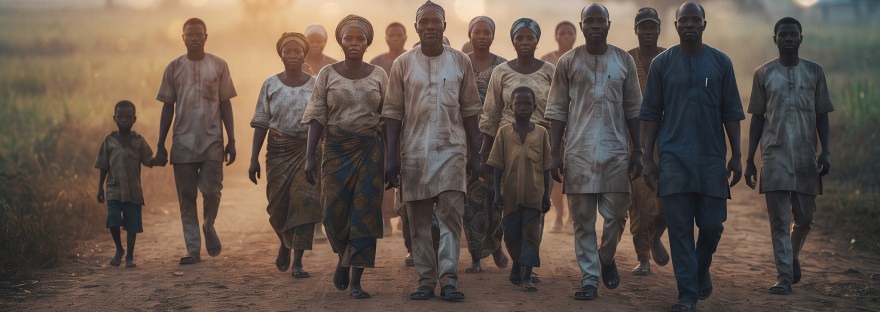
“I have a dream…that one day, the generality of Nigerians would be proud to stay home and say that truly the land is green”
Martin, Not Luther the King, 1960
Somewhere within the territory of Nigeria on 1 October 1960, a young lady brimmed with hope as the Union Jack was lowered and Taiwo Akinkunmi’s green and white design leaped upwards. Sixty years later, blessed with the longevity that few of her peers were fortunate to enjoy, she looks at the silvery bouquet staring at her in the mirror and wonders how her Nigeria could have failed her so terribly. As she reminisces about the decades gone by, she contrasts the naivety of her youth with the wisdom of lived time and concludes that out of the broken pieces of the past, her Nigeria can still build an edifice of hope.
This article is being drafted few days after a courageous, or maybe slightly crazy, investigative journalist, Fisayo Soyombo, published a series of articles recounting his journey attempting to move across the Sahara Desert from Nigeria to Libya, with Europe as the final destination. But like the movie, Final Destination, the journey could aptly be renamed “1000 Ways to Die”, seeing the horrors that Nigerians (and other African migrants) face in trying to seek a better life. For anyone to willingly risk starvation, injury, rape, slavery, imprisonment, and even death on the road to Europe, clearly the person has no hope in thriving within Nigeria’s borders. Although this sense of hopelessness could be argued to be somewhat misguided, it is a view that is unfortunately shared by a significant number of Nigerians.
Before we continue using the word “hope” and its literary associates, it should be clear that the word predates any political campaign slogan. Therefore, nothing in this piece should be construed as an endorsement of any electioneering campaign.
So, we ask why many Nigerians feel hopeless. When the economy’s fundamentals are such that a large mass of the populace have to include begging as an income source in their budgets, or many are afraid to use the roads for long distance journeys, it is hard to demand hope. When government entities bet against the national currency and the government appears to be more interested in squeezing the next kobo from the hands of the populace rather than cutting down on superfluous projects and ostentatious wastages of scarce resources, hope may seem far away. When the mere sight of a police officer’s uniform can trigger a traumatic response in citizens battered by years of brutality and armed robbery packaged as extortion, hopelessness can thrive.
We can go on with more examples to justify why Nigerians would feel that tomorrow would be worse than yesterday. However, I choose to take the other road and hold on to hope. Of course, if you stick to a literal interpretation of socioeconomic indices and trends amid the context of societal malaise, you may want to be cynical. But cynicism easily takes you down a rabbit hole of self-reinforcing destruction. If you do not think that tomorrow can be better, you are less likely to take any decision today that depends on a better future to realise expected benefits. When this hopelessness is unleashed on a societal scale, you end up with individuals consistently making choices with short timescales that cumulatively undercut the probability of a better tomorrow.
Rather than wallow in hopelessness, we can choose to be like Abraham of Ur who chose, against all hope, to continue hoping that the future he had been promised would be actualised. Some persons have voiced grievances against “religion” for selling hope, but we can ask ourselves if we would feel safe in a society where all hope is lost, seeing that the worst of humanity is unleashed when people believe that there is no future worth fighting for, so anything goes. That is when the concept of “survival of the fittest” moves into far more destructive territory. Think of what happens in a bank run when the idea that a bank is going to fail leads to customers trooping in to demand their money, which then leads to the bank actually failing, except there is some intervention. That is an example of hopelessness at work.
So, as Nigeria marks 66 years of independence, we are better off choosing to hope and then translating that hope into actions to deliver more hope. When we hope that things can be better, we can motivate ourselves to participate in the coming elections, and vote for credible candidates that are particular about delivering a better future. We cannot vote on tribal and religious lines and wonder why incompetents end up running the society aground. When we are hopeful about the future, we can ignore the crooks who offer money on election day in exchange for votes. While there is a poverty component to vote selling, many who sell their votes do so because they do not think they have anything to gain in future. A politician who pays you ₦10,000 in return for a four-year tenure is leveraging on your inability to bet on yourself being able to earn multiples of that within a month and facilitate the enthronement of a competent leader who can implement policies that would save you from spending multiples of that bribe on hospital bills, food, bad roads, and other disbenefits of bad governance.
When we thrive in hope, we have a better chance at avoiding destructive short-term decisions and leveraging on delayed gratification to build a society that works for the generality of the population. When we believe that tomorrow can be better, we can see ourselves at work as co-creators of that future. We need a society that believes that tomorrow is worth fighting for. That is the only way we can effectively fight for tomorrow.
Across six decades, Nigeria has disappointed in many ways. But there have been some positives and glimmers of hope in our long walk to freedom. We should fix our gaze on the good aspects of the country and use that as mental stimulation to think about and work towards a working Nigeria, a nation where peace and justice reign.
Happy Independence Day, Nigeria!
Image generated by Google’s Gemini AI


