
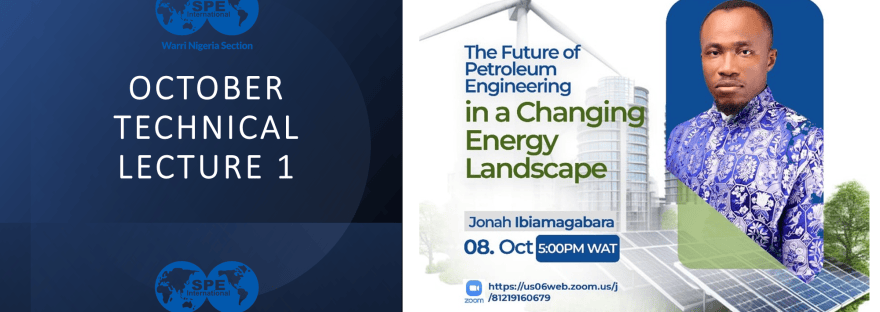
When the Society of Petroleum Engineers, Warri Section, reached out to ask that I anchor a technical session on the topic, I took some time to ponder on the petroleum industry amid the uncertainties in today’s world. The industry has had disruption as part of its DNA, so whatever challenges it faces today are just another iteration of catalysts that force adaptation.
My slide deck is available for download here.
The live presentation can also be watched via the SPE Warri Section’s YouTube Channel.
In arranging my thoughts, the outline was presented as a 3-2-4 formation, drawing inspiration from football idiosyncrasies. Hence, the presentation begins with three “defenders” showing how far the industry has evolved and its enduring relevance to the world in the midst of a fast-changing global landscape. Then the two “midfielders” hold the fort by placing a context to the discourse. In this section, I extended the known concept of the energy trilemma to an “energy pentalemma” showing the competition between different decision criteria in a bid to achieve an optimal energy system.
Meanwhile, as a Nigerian, the presentation had to be grounded in the Nigerian reality of prevalent energy poverty against the backdrop of significant oil and gas reserves. Nigeria faces a conundrum where much of the developed world says we need to move to cleaner energy sources, but we do not have the resources to make a forceful migration immediately. In the spirit of equity, I ask whether it is equitable to ask an energy-poor society to follow the same transition pathway as societies that industrialised using abundant fossil energy. As the world considers net-zero pathways, Nigeria would decide whether to prioritise emissions reduction per unit of energy, or absolute emissions reduction even where this constrains energy access.
The final part of the presentation had four “strikers” deployed to navigate the future, beginning with an acknowledgement that improving current petroleum engineering practices is the first step to future-proofing the industry. As the industry optimises its inputs and outputs, we can then look at transferring the deep knowledge ensconced within the industry towards cleaner energy sources, having recognised that the future is unlikely to be a contrast between fossils and renewables, but a form of cooperation and interdependency between both energy sources with the goal of ensuring affordable energy access for human activities.
On the talent side, industry practitioners seeking to have future-proof careers would have to position themselves as “T-shaped” energy professionals blending deep core technical expertise with a broad understanding of business context and efficiency enablers. Being able to link technical concepts to socioeconomic, environmental, and behavioural implications would be a value multiplier for developing future resilience.
Lastly, the final slide featured a “top-nine striker” with commitment to adaptation presented as the resilience guarantor for the industry. There is a saying that “attack is the best form of defence”, hence, rather than trying to “defend” petroleum engineering, the industry should be adapting to the future by leveraging on existing capabilities and developing new, broadly adaptable toolkits to continue meeting the primary objective of delivering affordable energy sustainably.
The future of petroleum engineering is one shared with renewable energy where capital allocation will reward the production of energy to meet human needs at the most optimal cost that balances production costs against environmental impact. This is the crux of the presentation. The industry mantra should become “Doing More With Less”. By continuously adapting to global and local realities and learning to deliver more useful energy with fewer wasted resources and lower environmental impact, we would build resilience to remain relevant regardless of what the future unfolds.


