

Since its inception, the Economic Community of West African States (ECOWAS) has championed the promise of deepening integration across the subregion to stimulate shared economic prosperity. Yet, decades into this experiment, regional integration remains frustratingly subpar—even if, by some small mercy, it fares slightly better than what obtains across the wider African continent. Officially, ECOWAS citizens enjoy the right to move visa-free across member states. In practice, however, one is forced to wonder if a borderless West Africa is merely a paper-thin ideal that the regional apparatus lacks the capacity to operationalize.
A jarring reminder of this reality unfolded on 19 June 2026, at the Murtala Muhammed International Airport in Lagos. A Nigerian professional, seeking to board a flight to Accra for an essential business trip, arrived at the terminal facing a unique predicament. His international passport had been caught in the bureaucratic gears of the Italian Embassy for over a month. Having previously retrieved it temporarily for another urgent engagement, returning it to European custody meant that clawing it back a second time on short notice was a bridge too far.
Aware of the ECOWAS protocol on the free movement of persons, he assumed that his West African counterparts would offer some institutional reprieve from the high-handedness of Western consular diplomacy. Secure in his possession of the newly upgraded ECOWAS biometric travel card—which was migrated from the old paper dockets precisely to enhance security and ease of transit—he approached the terminal confident that regional frameworks mattered. He was wrong.
The friction began at the pre-screening desk. Airport agents abruptly halted his progress, declaring that the biometric card was exclusively valid for land borders, not airports. A spirited debate ensued. It took a direct intervention from a senior Nigeria Immigration Service (NIS) official to confirm that the card indeed permitted air travel. Even then, the agents insisted on sighting a digital photo of his international passport data page. The systemic irony was stark: if regional transit requires an international passport to validate a regional biometric card, what exactly is the card’s sovereign utility? Compounding this was a total absence of clear, accessible official guidelines online to clarify the valid routes for the biometric card.
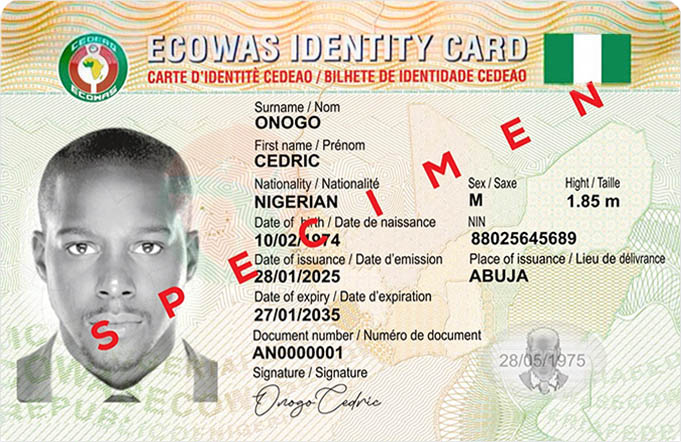
The systemic dysfunction only amplified further down the line. The airline check-in counter required a second round of verification before issuing a boarding pass. Upon reaching the immigration screening point, a front-line officer vehemently insisted that flying with the ECOWAS card was flatly impossible. It required a supervisor’s intervention to locate an officer who was actually aware of the clearance protocols for the card. This classic case of information asymmetry suggests that no uniform circular or directive had filtered down to the personnel tasked with executing subregional policy.
The climax of this administrative comedy of errors occurred at the boarding gate. As boarding commenced, airline officials informed the traveller that he could not fly. In a bid to manage their own risk—specifically, a punitive $5,000 fine for carrying an inadmissible passenger—the airline had proactively contacted Ghanaian immigration officials at Kotoka International Airport in Accra. The response from Accra was unequivocal that the traveller would be denied entry into Ghana upon arrival if he presented only the ECOWAS card. His boarding pass was revoked, and his checked luggage was pulled from the aircraft.
Watching this entire episode play out before my eyes was an exercise in profound disappointment. It is deeply baffling how a technological “upgrade” from a paper booklet to a secure biometric card has somehow yielded a structural “downgrade” in operational utility. Why should a biometric card be recognized at a land border but rejected at an international airport? More vexing still was the revelation that while Nigerian immigration officials in Lagos have been honourably accepting the ECOWAS cards presented by inbound Ghanaian citizens, their counterparts in Accra appeared content to disregard the core principle of diplomatic reciprocity.
Upon landing in Accra, I sought out Ghanaian immigration officials to verify the airline’s claim. When they confirmed that the biometric card was indeed barred for air arrivals, my immediate, visceral reaction was to mutter that the card was a worthless piece of plastic.
Of course, the card is not inherently worthless. But the systemic friction, administrative confusion, and lack of institutional synergy make it feel that way. If ECOWAS is serious about regional integration and enabling legitimate commerce, it must address these glaring operational gaps.
As I sat down to write this, I resolved to channel my frustration into formal action by writing directly to the leadership of the ECOWAS Commission. Regional integration cannot remain a lofty talking point for heads of state while citizens bear the brunt of administrative paralysis on the ground. It is time to demand that our regional identity documents live up to the weight of their promises. My letter might be ignored, or it might push responsible officials to ask why an ECOWAS citizen cannot travel within West Africa with the ECOWAS Card. That is a question worth asking.
Cover Image Credit: biometricupdate.com


