
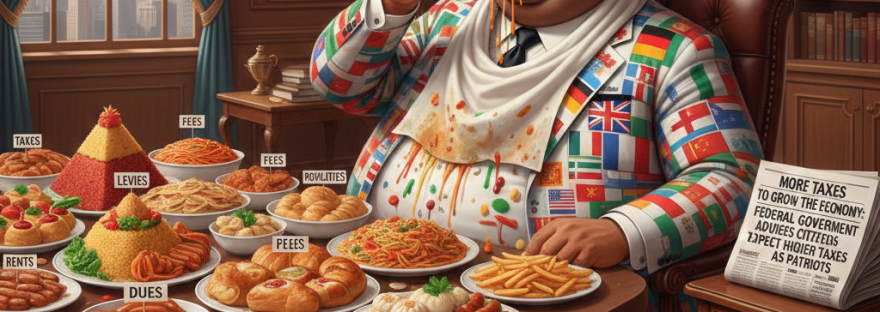
It is commonly said that when an individual’s income increases, expenditures, if unchecked, would rise to meet the income, and necessitate further increase in income. While individuals have their ability to singlehandedly increase their incomes constrained by factors associated with the value delivery or productivity (perceived or real) in the marketplace whether as business owners or employees, governments are largely unencumbered by value or productivity considerations thanks to taxation.
When we think of taxes, our minds immediately go to categories such as income tax, value added tax, and other tags conjured by governments seeking to further extract value from the populace regardless of whether commensurate value is received by the payers. However, while “visible taxes” are easily known to the populace, few persons consider other forms of “taxation” such as inflation, unrestrained loans, modulation of pensionable conditions, and reduction in the quantum and quality of public services delivered by the government. These are some hidden ways by which a government transforms into a rent-seeking entity divorced from its social contract with the populace.
At this time in Nigeria, there is a lot of talk about tax increments thanks to the 2025 Tax Acts and several government policies that seek to “widen the tax net” and squeeze more haemoglobin from those already caught in the net. But true to form, there is hardly any talk about cutting wastages that litter the government’s expenditures, nor a commitment to actually direct increased revenues to serve the people. You see, the challenge is that government models focus more on collection than delivering value.
Instructively, while Nigeria may seem like an extreme case, the problem is not limited to our borders. Across the globe, there are recurring voices screaming about taxes that keep rising and reducing the purchasing power of the people, while wastages abound from which the respective governments could have trimmed some fat to reallocate to more productive uses. For example, I recently had a conversation with someone about the cost of procuring public services in a Western country. From the synthesis of that conversation and available data from online reports, it was clear that in virtually every country, the same item would be procured cheaper by a private organisation than any government entity. While some may argue that private organisations seek the best possible deal due to a focus on profits while governments have to consider other factors beyond profit, the differential in the cost of buying say a 4WD truck in the private sector compared with the public sector would easily show that the procuring authorities in the public sector do not see themselves as being accountable for judicious use of the people’s taxes. If the government can easily squeeze out more money from the people or take loans to be repaid directly and indirectly by the people, why should public officials bother about cost efficiency?
Unfortunately, taxation has been enthroned as the holy grail of governance such that governments are evaluated on what portion of their gross domestic product is extracted via taxes. So, rather than seeking productivity enhancements, we end up with governments chasing tax metrics like some accursed beast desperate for a princess’s enchanted kiss to recover. But this should not continue unabated. At some point, grievances over the burden of taxation combined with reduced disposable incomes and poor public services could set off a wildfire that may consume some societies. Historically, taxes have been a torching point for societal conflagrations as seen in the Aba Women’s Riot, the split of the ancient Kingdom of Isreal, and the declaration of independence by the United States of America. If we do not want the chaos that can result from entrenched grievances, then we need to start pushing for responsible government spending.
That responsibility begins with public officials understanding that they exist to serve the people rather than being overlords to be challenged by no one. And we need to be able to demonstrate that there is value in having a government running things. When life appears to be so hard and people have to spend more to access essential services, many would readily start questioning the essence of having a government if they as individuals are practically functioning as self-governed enclaves despite bearing a heavy tax burden. So, before approving the procurement of bulletproof SUVs at inflated rates, maybe a responsible official should ask himself or herself whether those SUVs serve the interest of the people, or whether there is an alternative that would meet the wants of the officials and still allocate adequate funds for the needs of the people. It is in this consideration that governments would become financially responsible and attuned to the needs of the governed, and break the yoke of financial insatiability.
Image generated by Google’s Gemini

 Jilomes