
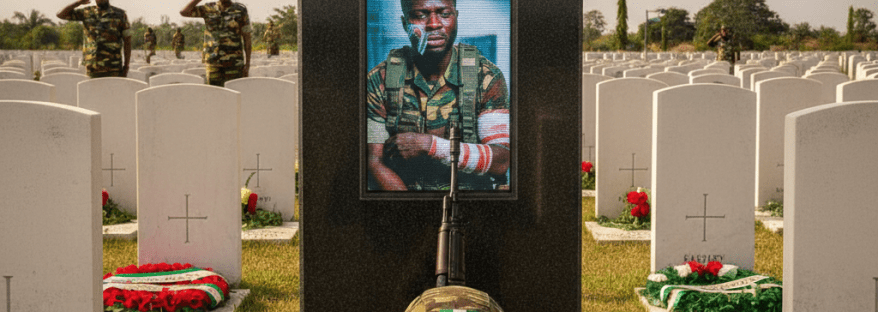
I was going to write this article early on 15 January 2025 to be able to post it in good time during the day, but here I am close to midnight, driven by a commitment to put down my thoughts even if it means the article comes a day late. But January 15 is not about me. It is about remembering thousands of Nigerian citizens, brothers and sisters in arms, who have served in the military whether by choice or compulsion, and have paid the supreme price. To these comrades, we remain eternally grateful because their blood is the currency that allows us to live our own lives the way we want.
First things first. The Armed Forces Remembrance Day was affixed to commemorate 15 January 1970, the day when the brutal Nigerian Civil War ended. For someone who believes that Nigeria is better together but against enforced unity, I have issues with the concept of “one indivisible nation” as this is one of the untruths we have forced ourselves to choke on, rather than honestly seek a framework of willing constituents united freely because they all see the benefits of a strong Nigeria. So, for me, 15 January is not about soldiers shooting people to remain Nigerians by force, but about soldiers in Chibok or Bakassi or Soku exchanging their lives, so the worst of humans do not get a chance to make life so untenable that engineers, doctors, traders, artists, and farmers have to transform into gun-wielding combatants to protect their families and communities.
In fairness, the average Nigerian has a bittersweet relationship with our military. When we face serious insecurity, we wish for the relative assurance announced by having gun-trotting men in whatever shade of green. At such times, we are proud and overjoyed to have the comfort of our military. But when we get shot at military checkpoints for taking a phone call, or brutalised by uncultured soldiers, or mocked as “bloody civilians” by ignorant personnel unaware that they were not born as soldiers, we mindfully renounce the idea of a loyal military and wish that such soldiers meet their nemesis. For many Nigerians, the military is feared not respected and that is a problem.
However, the military remains a bulwark for the country. Without them, terror groups would have gleefully expanded their reach into more areas and forced many of us to transform from online armchair analysts into mandatory untrained fighters to protect whatever is left of our communities. For me, having to work on projects in insecure areas, I have come to appreciate the men whose presence means our work teams can focus on delivering critical infrastructure without worrying whether we can return home safe. When you see soldiers detailed to protect you lose their lives, it recalibrates your mind about whatever grievances you may have against the military institution.
This does not mean that civilian grievances are invalid. Rather it presents a case for contextual consideration of extenuating circumstances or even the magnanimity to accept that while the military has a lot of repentance and possible restitution owed to Nigerians, our soldiers are sine qua non for our daily lives. These two truths can coexist. Meanwhile, our misbehaving soldiers are also victims of our national systemic dysfunction. It is said that hurt people hurt people. Our soldiers are drawn from a culture of power enforcement and oppression of the “less privileged”. We cannot realistically expect them to behave different from the systemic rot. So, if we can fix the culture that allows a “madam” to beat up her maid, then unfortunate humans cosplaying as soldiers would be less likely to brutalise a fellow citizen whose fast-rising taxes provide the funding for the soldiers’ salaries and appurtenances.
Before wrapping up, I need to chip in the Armed Forces Remembrance Day emblem, which for some reason is majorly sold at airports. If only a minute number of Nigerians are privileged to go through our airports, then limiting the emblem to airports could be a case of unhelpful elitism. We can get more Nigerians aware of, and willing to wear the emblem by having it available at major public venues like malls, parks, religious centres, etc. This could be an avenue to engage Nigerians to better understand the role of the military and the constraints with which our soldiers function.
And so we come to the point where we say thank you to our soldiers whether with boots in the field or supporting from the office. We remember all who have lost their lives in defence of fellow citizens and pray that their families are comforted and that their families are not cheated out of the benefits due to them. And we remember those in the military who treasonously act to betray their comrades for money or ideological / religious leanings. We hope that these demons face justice in this life and hereafter. We hope for a nation where our soldiers would be scarce on the streets but would gain their fighting experience in military drills and peacekeeping missions abroad rather than in multifaceted violence within our borders.
On 15 January, blood calls unto blood.
Image Credit: Google’s Gemini AI

 Jilomes