
How do you solve a problem that appears to be a little more complicated than rocket science? More than ten years after a cerebral Nigerian politician asserted that fixing Nigeria’s electricity supply conundrum “is not rocket science”, with some claims that he said a serious government could fix entrenched sectoral challenges within six months, there is arguably less electricity supply in “most” parts of Nigeria compared to a decade ago, and combined with rising costs, more persons are turning to solar power systems aka “inverter”.
Before we go on, let me quickly clarify that I have no fundamental beef with solar energy. With a master’s degree in renewable energy engineering, I know a few things about solar energy’s usefulness, but this article is coming from what I see as a dangerous trend for Nigeria.
Let us start with a fundamental problem with solarification in Nigeria. We are a people equipped with problem solving skills at an individual level but unable to solve societal problems. Bad roads? Buy a SUV (“Jeep”)! Home robberies? Install metal cages (“burglary proof”) on windows and doors and make fences higher! Dysfunctional public transport? Hustle to buy cars! Terrible public hospitals and schools? Do whatever you can to afford privately-run alternatives! We are literally the epicentre of the “I Pass My Neighbour” Tribe where we find a way to remove ourselves from societal problems, so our children and grandchildren still have to face the same unresolved problems decades later. With everyone looking for how to afford solar installations (including government agencies and the State House!), the problem with poor power supply gets shifted away from the elites’ consciousness and the result would be that as it was in 1984, so it could be in 2064, wahala without end.
The next issue is the consequential impact of losing a large chunk of the population with the ability to pay for electricity. Each time a “Band A” or commercial customer goes off the grid, that is one less customer to contribute to keeping public electricity utilities operational, and it sustains a rapid descent to rock bottom. The distribution companies (“discos”) are still hiding their heads in fast heating sands, but like I told a disco customer service agent when I called to complain about my Band A location being in darkness for almost a week, when you convince those who can afford to install solar systems to leave the grid, you are retaining only those who would usually struggle to afford paying electricity bills, so your business becomes more financially exposed and less resilient. Without high paying customers on the grid to support some level of subsidies for less capable segments, disco collections would become worse and trigger even worse supply conditions.
Solarification is also incredibly wasteful as it diverts significant capital that could have been applied to more productive uses. If you have a total load of, say 2 kW, you will likely need to install maybe twice or even thrice your load, so you are certain that under full demand, your home or office would be powered. However, for most operational times, your load would be less than 2 kW, so that’s a lot of capital wastefully deployed, whereas a large power plant could have generated a lot of power to serve thousands of buildings with capacity to ramp up and down as demand fluctuates, while costing less per unit of electricity delivered over its lifetime. So that is economies of scale that is being lost because of tiny units littering across our neighbourhoods.
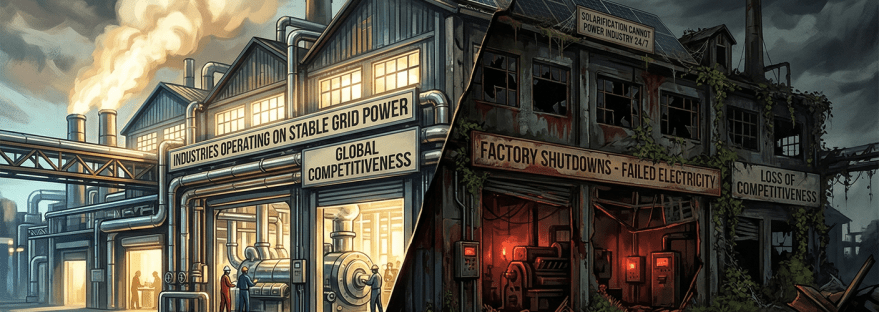
Another issue is that under current technological capabilities, no industrialised nation can function using solar power. Yes, solar power can serve as part of the energy mix of a nation, but there is a reason why China is simultaneously building massive coal plants while also expanding its renewable energy installations. The Chinese know that to stay globally competitive, they need cheap, reliable, easily ramp-able electricity to run their factories 24/7. This is a lesson that Europe is gradually coming to terms with, but we do not have to wait until we destroy the little industries we have or make them so uncompetitive due to relatively excessive energy costs before we understand why solarification is bad for industries.
In addition, whereas the global trend is for industries to use somewhere between 30% to 60% of a country’s electricity supply, in Nigeria, industries only consume about 15% of what the grid supplies (Global Electricity, IEA, IEA). The International Energy Agency estimates that about 44% of electricity supplied in Nigeria is consumed by residential areas. This is despite Nigeria being a warm country that does not have the significant heating requirements of cold countries. Very clearly, we are already in a bad state with few industries and a good number of our large industries already running their own diesel or gas generators. If we then fast-track solarification, we will end up with even more industries attempting to go off the grid, becoming more uncompetitive, possibly laying off workers and exacerbating our unemployment problem.
Finally, a major problem I see is the loss of technical knowledge if we move towards miniature distributed solar systems in place of large-scale functional grid-supplied electricity. Just as Europe and America exported a lot of manufacturing capabilities abroad and now have less persons with certain technical skills, by de-emphasizing grid dependence, the technical skillset required to manage complex interconnections would be gradually lost and we may find ourselves someday without the capacity to manage resilient grid systems that are needed to underpin industrial development.
So, what should we do? I think that first of all, we need to demonstrate political will to address the issues with the power sector. I will concede that fixing our power problems is a little more complicated than rocket science, especially considering several contextual factors, but political will is the chief cornerstone that we need to get things right. Political will also means that the State House cannot be announcing a major solar installation as an attestation that even the powers that be have given up on grid power. Political will means prioritizing technical competence and meritocracy rather than nepotism in appointing sectoral leaders. It also means avoiding wasteful duplication of government entities set up to solve overlapping problems. It also means demonstrating leadership by ensuring that ALL government establishments pay up legacy debts and are migrated to prepaid metering to stop the shame of serially defaulting on payments for consumed electricity. It also means enforcing the sanctity of contracts across the electricity value chain with consequences for failure of any party to meet its obligations whether at the supply or demand side. It means publicly prosecuting persons that bypass meters and disco personnel who conspire with consumers to divert payments. It also means facilitating the implementation of the Electricity Act to allow states take responsibility for their localities and enabling competition among states to grow as they wish while enforcing standards for interconnection protocols to enable grid resilience and provide fallback options in emergencies.
However, political will alone may not address the lack of transparency and mounting debts that accrue to each player in the power sector, which contributes to the lack of investment in electricity supply and upstream gas production. So, my suggestion would be to try something unusual and implement a waterfall approach for electricity revenues like what is done in arranging some commercial loan repayments. The basis is that as at today, there is no “known” independent verification of how much discos collect and my anecdotal assumption is that discos have an arguable interest in maintaining the current collections framework with significant losses carried each year, while stakeholders upstream of distribution depend on whatever the discos send upwards. So, why not consider a system where all the participants come together and agree on a percentage of collections to be allocated to each segment and the collections for each disco go into an escrow account that is monitored by all players in that region. At the end of the month, each party gets its share of the agreed tariff, which can be renegotiated maybe twice a year based on changing cost structures for each party. This way, distribution companies, the transmission company, generating companies, gas transporters, and gas producers are guaranteed a transparent payment each month, and discos could be incentivized to address technical and commercial losses and expedite metering. A sweetener could be added where for every percentage increase in collections, discos get a higher percentage than the baseline amount, so there is an even stronger incentive to rake in more funds to improve their bottom line. Maybe this would improve liquidity in the sector and attract more investors to grow our electricity supply capacity. Outside this regulator-managed framework, sectorial players can still enter willing buyer – willing seller arrangements to supply electricity to specific areas.
Of course, the idea put out here is unrefined but industry professionals who understand other contextual factors within the power sector can work with strong political will by the government to turn the tide before more people lose hope in the sector. Solarification is a temporary fix that is a net negative for Nigeria’s future. Therefore, we need to address the reasons why tiny distributed solar systems are becoming widespread. If we boldly address the issues today, we will have a future where Nigerians enjoy a robust energy mix with solar power plants contributing their share in a robust interconnected system of national, regional, and micro grids, with miniature solar systems serving emergency functions rather than being the main deal. By then, we will not have Nigerians making caricatures of the Minister of Power because they will have power to enjoy cool air during heatwaves.
Image generated by Google’s Gemini

 Jilomes