

Today is Father’s Day, which, bless the Lord, we are happy not to share with the other day that commemorates toilets. Here I am on Father’s Day, in a hotel far from home, but rather than reflecting on the blessedness of fatherhood, I am scribbling words on another issue that has been on my mind for a bit. I have written in the past on Father’s Day, but today, let me lament on the society’s gradual slide away from the humaneness of humanity.
First, we begin with an elaborate social engineering scam on LinkedIn. A random person sent me a connection request and later reached out to plead for “transport fare” to assume duty at a government agency. I was not convinced that this was a genuine request, but having been in a situation where I needed money to travel for an interview, I decided to give this person the benefit of doubt. For me, it was better to lose the little money being requested to a scammer than having to risk a genuine person losing what could be a life-changing opportunity.
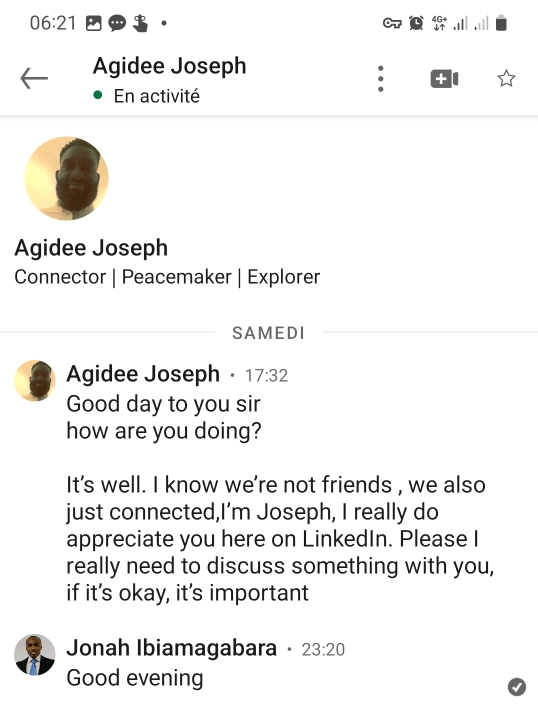
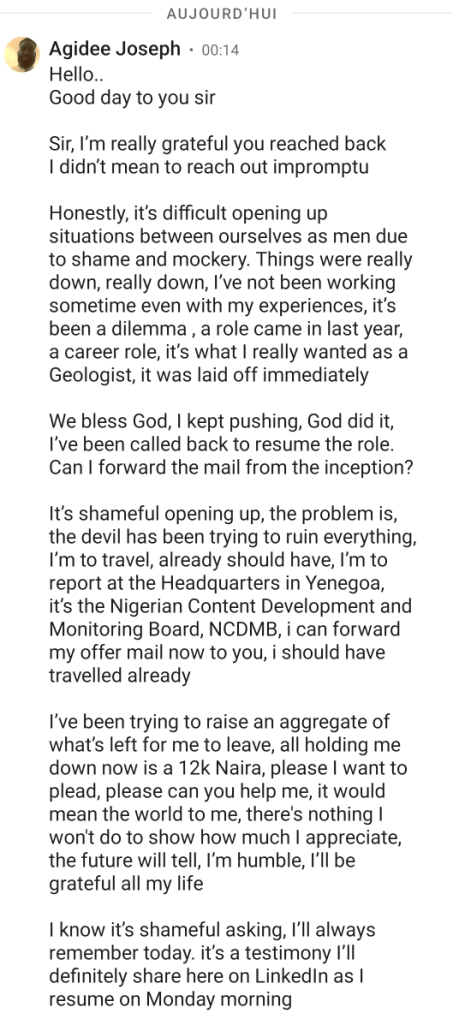
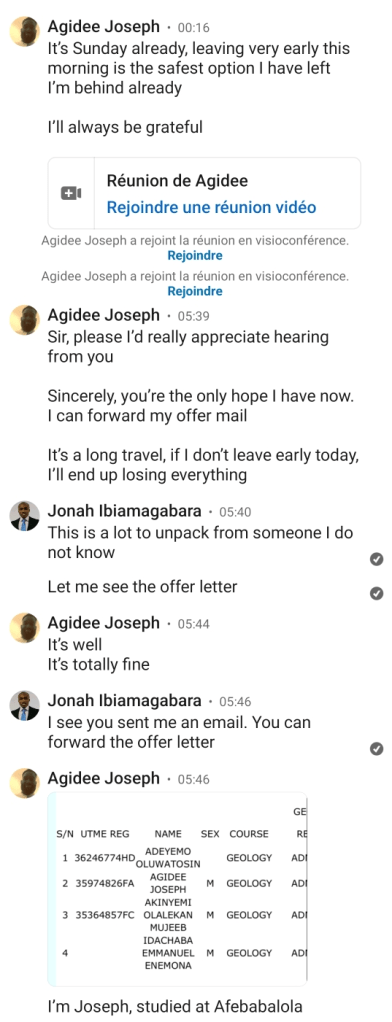




The screenshots above show my conversations with this person. I took a long continuous screenshot because something just did not feel right about the request. Lo and behold, I checked back a few days later and the entire conversation had disappeared, just as this scammer’s LinkedIn account had also vanished. So, some clown executed an elaborate scheme incorporating the right amounts of emotional inferences to make a call on my humanity just to get ₦10,000 (~US$14). Imagine if he had diverted such energy into a career in sales!
Should I blame myself for being stupid? Well, I think not, but I wonder how this would affect the next stranger who meets me with a genuine request. We see many persons who say they do not offer help to anyone they do not know, and we sometimes want to see them as “wicked people” without asking what could have triggered them to see rendering help as equivalent to being scammed. Little by little, we are stripping normal humans of “human feeling”; grooming unemotional robots who would not care if anyone needed help as long as such a person did not fall under close “family and friends”.
Something similar plays out on Nigerian roads. I was discussing with someone who said he drove past an accident scene because he was not ready to get into any trouble with the Nigerian Police Force. When you help transport someone to a hospital only to get arrested by the police, you are likely to avoid rendering such help in future. But then, my worry is that as we are being coached to mind our business, what happens on a day when we are the ones by the road who need a stranger’s help?
We move on to the developed world where rules ostensibly emplaced to prevent jungle justice have effectively criminalized offering help. There was a video of an attacker harassing a woman on a train, and some of us wondered why no one intervened. However, our wonder was resolved when we saw someone getting arrested for tackling another attacker on a different train. In effect, someone could see a lady being raped, but would “mind his business” because he does not want to risk getting arrested for attacking a rapist. The same mindset is causing several shops to be shut down in some US cities because thieves are attacking shops, but the average citizen is better off minding his or her business.
On the gender and relationship side, there has been at least one famous person complaining that she was carrying several bags and no one (read: “male”) offered to help her. But why should we expect chivalry in a time when some random lady might get offended by a guy offering to help her carry a heavy load, because to her, his offer “belittles her capability”. The same applies to relationships where we are increasingly seeing relationships and marriages as a game of chess where each person is trying to ensure he or she holds the upper end of the stick, so we become less trusting, less willing to make sacrifices in honour of love, but more willing to exploit the next person.
Little by little, we are becoming uncaring robots, but we are not entirely to blame for this. When a full-bodied human decides to scam another person, we are unwinding the strings of trust that hold the society together. When the police arrests a Good Samaritan, we are telling others that doing good is bad. When a good lover is taken for granted and painted as a fool, we are telling good people that bad is better. Someday, we would look back and wonder where went all our humanity. Maybe, just as we are redefining many things today, we would then have to redefine what it means to be humane; ensuring that the new definition would meet criteria specified by unfeeling robots.
Image Credit: rsvpdesign.co.uk

 Jilomes
It’s really sad the level we all have become inhumane. It’s a typically because of our past experiences as you pictured it.
LikeLike